

Windsor Farms, Virginia
Market Monitor & Neighborhood Narrative
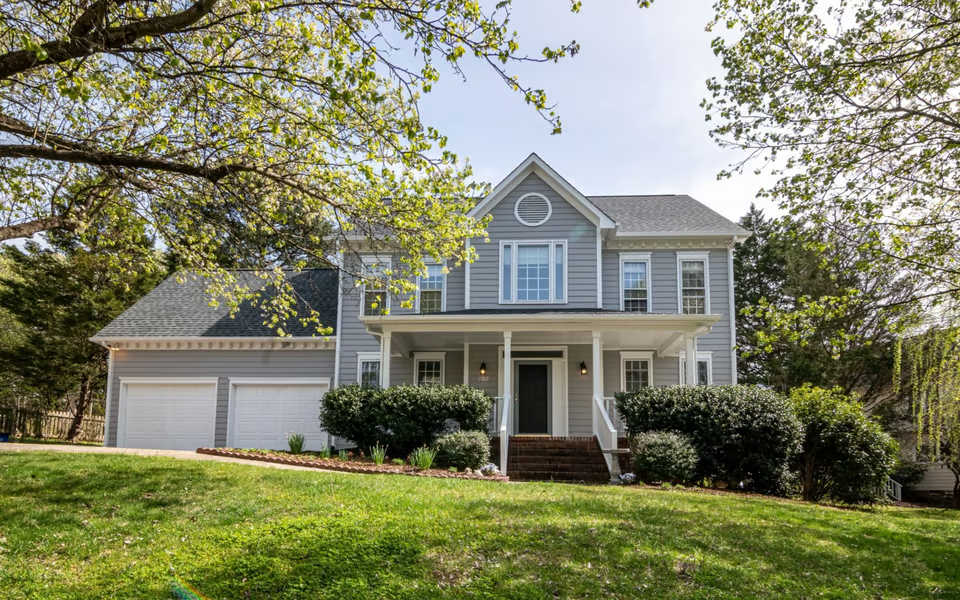
Windsor Farms
Richmond’s ultra-prime Garden City enclave—pastoral seclusion with true 10–15 minute CBD access.
A historically curated “English Village” planned in 1926 with curving streets, common greens, and strict architectural governance—built for scarcity, stability, and long-run value insulation.
Market Metrics
$1,629,148
Median Price
97%
Ownership Rate
0.5–2.0+ acres
Lot Size

Strategic Overview
Executive Summary
Connectivity
Central Access Logic
Airport: Not stated in report
Downtown: 10–15 minutes
Short Pump: 15–20 minutes
Minutes (illustrative)

Value “Moat” Governance
Strict covenants and architectural review preserve character and suppress supply elasticity, supporting long-run pricing power.

Noise Reality Check
Metroplex Strategic Placement
Windsor Farms Strategic Location
How close is Windsor Farms to Downtown Richmond in real driving time?
Typically 10–15 minutes. The report notes an efficient commute to the CBD via the Downtown Expressway or Cary Street, keeping access fast despite the neighborhood’s low-through-traffic design.
Does Windsor Farms feel secluded even though it’s near major city corridors?
Yes—by design. The curvilinear street network was engineered to discourage through-traffic, creating pastoral calm while remaining urban-adjacent.
What commercial areas do residents use most often day-to-day?
Carytown is the primary “downtown.” The report frames Carytown as the premier nearby shopping/dining corridor, with Scott’s Addition adding nightlife and brewery culture.
Is Windsor Farms walkable for errands and services?
Not for errands—mostly for recreation. The neighborhood is described as car-dependent due to strict residential zoning, but walking is common for leisure under the tree canopy.
How quickly can residents reach Short Pump retail and malls?
Roughly 15–20 minutes. The report cites a typical westbound drive to Short Pump Town Center within that window.
Do flight paths or airspace routing affect the neighborhood?
They can—intermittently. Windsor Farms sits beneath vectoring airspace for Richmond International Airport, and route changes can shift jet-noise exposure over time.
Market Queries
Windsor Farms Essentials
What is the current median price level in Windsor Farms?
About $1,629,148. The report estimates the median price at $1,629,148 with roughly 5.1% year-over-year appreciation.
Is Windsor Farms a competitive market when a good home hits the market?
Yes—inventory scarcity drives urgency. The report describes an “ultra-prime” enclave with strong competition, including examples of best-in-class homes selling materially over ask.
What is the typical lot-size range buyers should expect?
Commonly 0.5 to 2.0+ acres. The neighborhood’s positioning is explicitly tied to estate-scale parcels and privacy through setbacks and street geometry.
How owner-occupied is Windsor Farms compared to most neighborhoods?
Very—around 97% owner-occupied. The report notes an overwhelmingly owner-occupied profile with only a niche rental market.
Is the housing stock mainly single-family, or is there meaningful multi-family inventory?
It is structurally single-family by restriction. The report notes lots are strictly limited to single-family residential use, precluding subdivision into multi-family units.
What’s the biggest “hidden” lifestyle friction buyers should underwrite?
Noise events from rail and evolving air routing. The report flags late-night train-horn disturbances from adjacent active rail lines and notes airport vectoring routes can change noise exposure patterns.
Windsor Farms, Virginia
Market Monitor & Neighborhood Narrative
Windsor Farms:
Richmond’s ultra-prime Garden City enclave—pastoral seclusion with true 10–15 minute CBD access.
A historically curated “English Village” planned in 1926 with curving streets, common greens, and strict architectural governance—built for scarcity, stability, and long-run value insulation.
Strategic Overview
Executive Summary
Windsor Farms is a planned Garden City artifact inside Richmond—deliberately curvilinear, visually cohesive, and engineered to suppress through-traffic while preserving a “park-like” estate atmosphere.
As of early 2026, it behaves as an ultra-prime micro-market with a ~$1.63M median price, rapid liquidity, and a governance moat—yet buyers should price in the real-world friction of aging infrastructure risk and late-night train-horn noise from adjacent active rail corridors.
Market Metrics
$1,629,148
Median Price
Ultra-prime Richmond benchmark; scarcity-driven demand.
97%
Ownership Rate
Owner-occupied stability with minimal rental turnover.
0.5–2.0+ acres
Lot Size
Estate-scale parcels with setbacks and tree canopy.
Connectivity
Central Access Logic
Windsor Farms holds a rare “quiet-core / fast-access” profile: the street geometry reduces cut-through traffic, but the CBD commute stays consistently short via major east–west corridors.
Airport: Not stated in report
Downtown: 10–15 minutes
Short Pump: 15–20 minutes
Minutes (illustrative)

Value “Moat” Governance
Strict covenants and architectural review preserve character and suppress supply elasticity, supporting long-run pricing power.

Noise Reality Check
Active rail lines can produce late-night horn events; flight-path vectoring can shift jet-noise patterns over time.
Metroplex Strategic Placement
Windsor Farms Strategic Location
How close is Windsor Farms to Downtown Richmond in real driving time?
Typically 10–15 minutes. The report notes an efficient commute to the CBD via the Downtown Expressway or Cary Street, keeping access fast despite the neighborhood’s low-through-traffic design.
Does Windsor Farms feel secluded even though it’s near major city corridors?
Yes—by design. The curvilinear street network was engineered to discourage through-traffic, creating pastoral calm while remaining urban-adjacent.
What commercial areas do residents use most often day-to-day?
Carytown is the primary “downtown.” The report frames Carytown as the premier nearby shopping/dining corridor, with Scott’s Addition adding nightlife and brewery culture.
Is Windsor Farms walkable for errands and services?
Not for errands—mostly for recreation. The neighborhood is described as car-dependent due to strict residential zoning, but walking is common for leisure under the tree canopy.
How quickly can residents reach Short Pump retail and malls?
Roughly 15–20 minutes. The report cites a typical westbound drive to Short Pump Town Center within that window.
Do flight paths or airspace routing affect the neighborhood?
They can—intermittently. Windsor Farms sits beneath vectoring airspace for Richmond International Airport, and route changes can shift jet-noise exposure over time.
Market Queries
Windsor Farms Essentials
What is the current median price level in Windsor Farms?
About $1,629,148. The report estimates the median price at $1,629,148 with roughly 5.1% year-over-year appreciation.
Is Windsor Farms a competitive market when a good home hits the market?
Yes—inventory scarcity drives urgency. The report describes an “ultra-prime” enclave with strong competition, including examples of best-in-class homes selling materially over ask.
What is the typical lot-size range buyers should expect?
Commonly 0.5 to 2.0+ acres. The neighborhood’s positioning is explicitly tied to estate-scale parcels and privacy through setbacks and street geometry.
How owner-occupied is Windsor Farms compared to most neighborhoods?
Very—around 97% owner-occupied. The report notes an overwhelmingly owner-occupied profile with only a niche rental market.
Is the housing stock mainly single-family, or is there meaningful multi-family inventory?
It is structurally single-family by restriction. The report notes lots are strictly limited to single-family residential use, precluding subdivision into multi-family units.
What’s the biggest “hidden” lifestyle friction buyers should underwrite?
Noise events from rail and evolving air routing. The report flags late-night train-horn disturbances from adjacent active rail lines and notes airport vectoring routes can change noise exposure patterns.
Windsor Farms, Virginia
Market Monitor & Neighborhood Narrative
Windsor Farms:
Richmond’s ultra-prime Garden City enclave—pastoral seclusion with true 10–15 minute CBD access.
A historically curated “English Village” planned in 1926 with curving streets, common greens, and strict architectural governance—built for scarcity, stability, and long-run value insulation.
Strategic Overview
Executive Summary
Windsor Farms is a planned Garden City artifact inside Richmond—deliberately curvilinear, visually cohesive, and engineered to suppress through-traffic while preserving a “park-like” estate atmosphere.
As of early 2026, it behaves as an ultra-prime micro-market with a ~$1.63M median price, rapid liquidity, and a governance moat—yet buyers should price in the real-world friction of aging infrastructure risk and late-night train-horn noise from adjacent active rail corridors.
Market Metrics
$1,629,148
Median Price
Ultra-prime Richmond benchmark; scarcity-driven demand.
97%
Ownership Rate
Owner-occupied stability with minimal rental turnover.
0.5–2.0+ acres
Lot Size
Estate-scale parcels with setbacks and tree canopy.
Connectivity
Central Access Logic
Windsor Farms holds a rare “quiet-core / fast-access” profile: the street geometry reduces cut-through traffic, but the CBD commute stays consistently short via major east–west corridors.
Airport: Not stated in report
Downtown: 10–15 minutes
Short Pump: 15–20 minutes
Minutes (illustrative)
Value “Moat” Governance
Strict covenants and architectural review preserve character and suppress supply elasticity, supporting long-run pricing power.
Noise Reality Check
Active rail lines can produce late-night horn events; flight-path vectoring can shift jet-noise patterns over time.
Metroplex Strategic Placement
Windsor Farms Strategic Location
How close is Windsor Farms to Downtown Richmond in real driving time?
Typically 10–15 minutes. The report notes an efficient commute to the CBD via the Downtown Expressway or Cary Street, keeping access fast despite the neighborhood’s low-through-traffic design.
Does Windsor Farms feel secluded even though it’s near major city corridors?
Yes—by design. The curvilinear street network was engineered to discourage through-traffic, creating pastoral calm while remaining urban-adjacent.
What commercial areas do residents use most often day-to-day?
Carytown is the primary “downtown.” The report frames Carytown as the premier nearby shopping/dining corridor, with Scott’s Addition adding nightlife and brewery culture.
Is Windsor Farms walkable for errands and services?
Not for errands—mostly for recreation. The neighborhood is described as car-dependent due to strict residential zoning, but walking is common for leisure under the tree canopy.
How quickly can residents reach Short Pump retail and malls?
Roughly 15–20 minutes. The report cites a typical westbound drive to Short Pump Town Center within that window.
Do flight paths or airspace routing affect the neighborhood?
They can—intermittently. Windsor Farms sits beneath vectoring airspace for Richmond International Airport, and route changes can shift jet-noise exposure over time.
Market Queries
Windsor Farms Essentials
What is the current median price level in Windsor Farms?
About $1,629,148. The report estimates the median price at $1,629,148 with roughly 5.1% year-over-year appreciation.
Is Windsor Farms a competitive market when a good home hits the market?
Yes—inventory scarcity drives urgency. The report describes an “ultra-prime” enclave with strong competition, including examples of best-in-class homes selling materially over ask.
What is the typical lot-size range buyers should expect?
Commonly 0.5 to 2.0+ acres. The neighborhood’s positioning is explicitly tied to estate-scale parcels and privacy through setbacks and street geometry.
How owner-occupied is Windsor Farms compared to most neighborhoods?
Very—around 97% owner-occupied. The report notes an overwhelmingly owner-occupied profile with only a niche rental market.
Is the housing stock mainly single-family, or is there meaningful multi-family inventory?
It is structurally single-family by restriction. The report notes lots are strictly limited to single-family residential use, precluding subdivision into multi-family units.
What’s the biggest “hidden” lifestyle friction buyers should underwrite?
Noise events from rail and evolving air routing. The report flags late-night train-horn disturbances from adjacent active rail lines and notes airport vectoring routes can change noise exposure patterns.