

Richmond, Virginia
Market Monitor & Neighborhood Narrative
Richmond
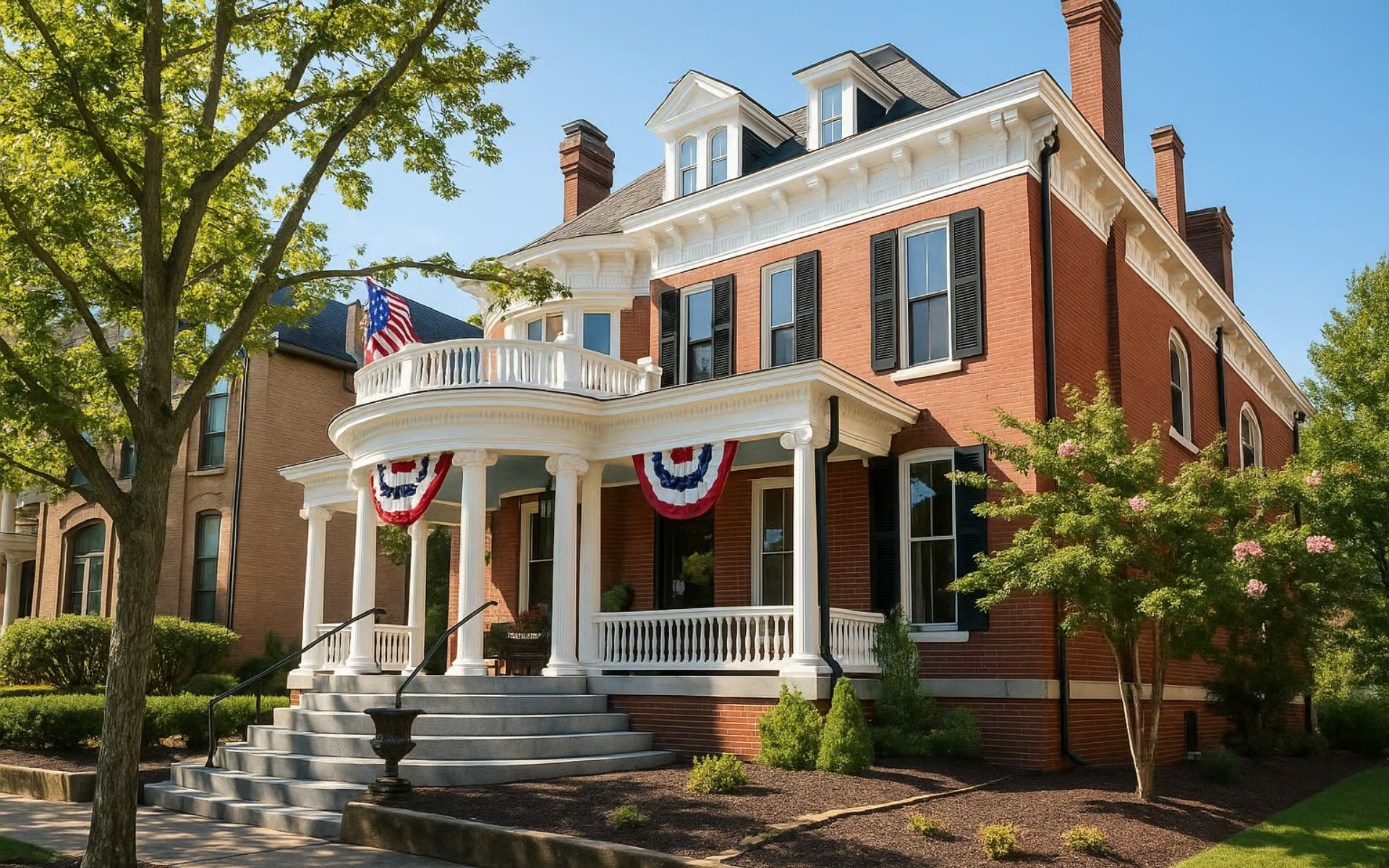
The Fan is Richmond’s “blue-chip” historic district with true 15-minute living.
An 85-block, porch-lined, Victorian/Edwardian neighborhood immediately west of the CBD and next to VCU—defined by constrained inventory, preservation rules, high walkability, and steady demand.
Market Metrics
$690,000
Median Price
Higher in Upper Fan; rental-heavy in Lower Fan
Ownership Rate
~0.06–0.09 acres (typical)
Lot Size

Strategic Overview
Executive Summary
Connectivity
Central Access Logic
Airport: ~20 min
Downtown: ~8 min
Minutes (illustrative)

Walkability That Actually Works
Walk Scores sit in the mid-90s—errands, dining, and culture are built into the grid.

Supply-Constrained Price Stability
Metroplex Strategic Placement
Richmond Strategic Location
Where does The Fan sit relative to Downtown and VCU?
It’s immediately west of Downtown and directly adjacent to VCU. The neighborhood functions as Richmond’s urban bridge between the CBD and the west-side residential districts, with university influence strongest in the Lower Fan.
What are the official boundaries that define The Fan?
The Fan is bounded by major arterials on all sides. Monroe Park/Belvidere to the east, Arthur Ashe Boulevard to the west, Broad Street to the north, and VA-195/Main Street to the south.
Why is it called “The Fan”?
The name comes from the street grid physically fanning outward. As Broad and Main diverge west of Monroe Park, the residential streets between them spread, creating a wedge-shaped pattern.
How fast is a typical downtown commute?
Downtown is typically a 5–10 minute drive. Many residents also bike (~15 minutes) or use the Pulse BRT (~10–15 minutes) for CBD access.
Is The Fan better for reverse commutes to west-side job centers?
Yes—reverse commutes are one of the neighborhood’s hidden advantages. Capital One West Creek runs about 20–25 minutes, and Short Pump/Innsbrook is typically 20–30 minutes, depending on I-64 conditions.
What’s the difference between the Upper Fan and the Lower Fan?
Lower Fan is denser and more rental-driven; Upper Fan is quieter and more owner-occupied. The dividing line is commonly Lombardy or Meadow, with premiums increasing as you move west toward Arthur Ashe Boulevard.
Market Queries
Richmond Essentials
What does “blue-chip” mean in The Fan’s housing market?
It means demand stays high because supply can’t easily expand. Preservation overlays and limited buildable land constrain inventory, supporting long-term price resilience.
What is the median sale price right now?
Median pricing sits around $690,000 as of early 2026. That stability follows a prior surge, indicating a high but steady plateau in a competitive, low-inventory market.
How fast do homes typically sell?
Expect about ~20 days on market on average. Desirable properties can go pending in under 10 days, with sale-to-list hovering around ~99–100%.
What does the entry-level price band look like?
Entry-level is roughly $300k–$550k and is mostly condos or unrenovated shells. Finding a move-in-ready single-family home in that range is described as virtually impossible.
What is the core “move-up” band for typical row houses?
The core band is about $600k–$850k for functional 3–4 bedroom row houses. This segment often centers on the Upper Fan and streets like Meadow and Hanover.
What defines the luxury tier in The Fan?
Luxury generally starts around $900k and can exceed $1.5M+. It’s typically fully renovated, wider row homes or prime addresses (Monument/Grace), often with off-street parking and preserved historic details.
Richmond, Virginia
Market Monitor & Neighborhood Narrative
Richmond:
The Fan is Richmond’s “blue-chip” historic district with true 15-minute living.
An 85-block, porch-lined, Victorian/Edwardian neighborhood immediately west of the CBD and next to VCU—defined by constrained inventory, preservation rules, high walkability, and steady demand.
Strategic Overview
Executive Summary
The Fan stands as one of Virginia’s most architecturally significant urban neighborhoods—an established, high-demand residential market centered on intact historic housing and a dense, pedestrian-first lifestyle.
With inventory constrained by preservation overlays and limited buildable land, values have stabilized near a $690,000 median, while prime renovated assets in the Upper Fan and on Monument Avenue commonly trade above $1M.
Market Metrics
$690,000
Median Price
Stable price plateau in a supply-constrained historic market.
Higher in Upper Fan; rental-heavy in Lower Fan
Ownership Rate
Owner-occupancy rises west of Lombardy/Meadow; student rentals concentrate east.
~0.06–0.09 acres (typical)
Lot Size
Typical lots run ~20–25 ft wide by ~120–150 ft deep.
Connectivity
Central Access Logic
The Fan sits directly between Richmond’s CBD and its western residential/commercial corridors, with quick access to VA-195 and Broad Street transit—making downtown trips short and reverse commutes to major west-side job centers realistic.
Airport: ~20 min
Downtown: ~8 min
Minutes (illustrative)

Walkability That Actually Works
Walk Scores sit in the mid-90s—errands, dining, and culture are built into the grid.

Supply-Constrained Price Stability
Preservation rules and limited buildable land keep inventory tight and values resilient.
Metroplex Strategic Placement
Richmond Strategic Location
Where does The Fan sit relative to Downtown and VCU?
It’s immediately west of Downtown and directly adjacent to VCU. The neighborhood functions as Richmond’s urban bridge between the CBD and the west-side residential districts, with university influence strongest in the Lower Fan.
What are the official boundaries that define The Fan?
The Fan is bounded by major arterials on all sides. Monroe Park/Belvidere to the east, Arthur Ashe Boulevard to the west, Broad Street to the north, and VA-195/Main Street to the south.
Why is it called “The Fan”?
The name comes from the street grid physically fanning outward. As Broad and Main diverge west of Monroe Park, the residential streets between them spread, creating a wedge-shaped pattern.
How fast is a typical downtown commute?
Downtown is typically a 5–10 minute drive. Many residents also bike (~15 minutes) or use the Pulse BRT (~10–15 minutes) for CBD access.
Is The Fan better for reverse commutes to west-side job centers?
Yes—reverse commutes are one of the neighborhood’s hidden advantages. Capital One West Creek runs about 20–25 minutes, and Short Pump/Innsbrook is typically 20–30 minutes, depending on I-64 conditions.
What’s the difference between the Upper Fan and the Lower Fan?
Lower Fan is denser and more rental-driven; Upper Fan is quieter and more owner-occupied. The dividing line is commonly Lombardy or Meadow, with premiums increasing as you move west toward Arthur Ashe Boulevard.
Market Queries
Richmond Essentials
What does “blue-chip” mean in The Fan’s housing market?
It means demand stays high because supply can’t easily expand. Preservation overlays and limited buildable land constrain inventory, supporting long-term price resilience.
What is the median sale price right now?
Median pricing sits around $690,000 as of early 2026. That stability follows a prior surge, indicating a high but steady plateau in a competitive, low-inventory market.
How fast do homes typically sell?
Expect about ~20 days on market on average. Desirable properties can go pending in under 10 days, with sale-to-list hovering around ~99–100%.
What does the entry-level price band look like?
Entry-level is roughly $300k–$550k and is mostly condos or unrenovated shells. Finding a move-in-ready single-family home in that range is described as virtually impossible.
What is the core “move-up” band for typical row houses?
The core band is about $600k–$850k for functional 3–4 bedroom row houses. This segment often centers on the Upper Fan and streets like Meadow and Hanover.
What defines the luxury tier in The Fan?
Luxury generally starts around $900k and can exceed $1.5M+. It’s typically fully renovated, wider row homes or prime addresses (Monument/Grace), often with off-street parking and preserved historic details.